
The Circumstellar Habitable Zone (CHZ)
What do you need in order to have a planet that supports complex life? First, you need liquid water at the surface of the planet. But there is only a narrow range of temperatures that can support liquid water. It turns out that the size of the star that your planet orbits around has a lot to do with whether you get liquid water or not. A heavy, metal-rich star allows you to have a habitable planet far enough from the star so the planet can support liquid water on the planet’s surface while still being able to spin on its axis. The zone where a planet can have liquid water at the surface is called the circumstellar habitable zone (CHZ). A metal-rich star like our Sun is very massive, which moves the habitable zone out further away from the star. If our star were smaller, we would have to orbit much closer to the star in order to have liquid water at the surface. Unfortunately, if you go too close to the star, then your planet becomes tidally locked, like the moon is tidally locked to Earth. Tidally locked planets are inhospitable to life.
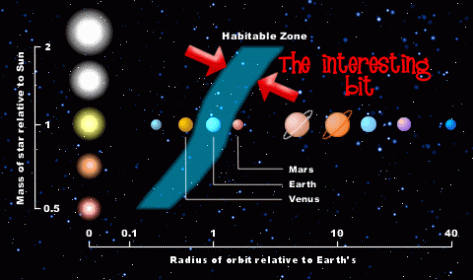
Here, watch a clip from The Privileged Planet: (Clip 4 of 12, full playlist here)
But there’s more.
The Galactic Habitable Zone (GHZ)
So, where do you get the heavy elements you need for your heavy metal-rich star?
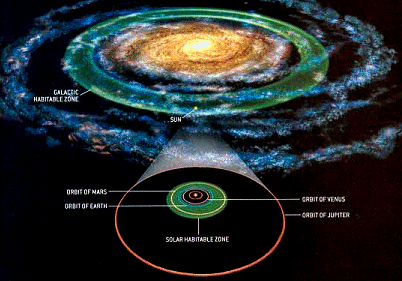
You have to get the heavy elements for your star from supernova explosions – explosions that occur when certain types of stars die. That’s where heavy elements come from. But you can’t be TOO CLOSE to the dying stars, because you will get hit by nasty radiation and explosions. So to get the heavy elements from the dying stars, your solar system needs to be in the galactic habitable zone (GHZ) – the zone where you can pickup the heavy elements you need but not get hit by radiation and explosions. The GHZ lies between the spiral arms of a spiral galaxy. Not only do you have to be in between the arms of the spiral galaxy, but you also cannot be too close to the center of the galaxy. The center of the galaxy is too dense and you will get hit with massive radiation that will break down your life chemistry. But you also can’t be too far from the center, because you won’t get enough heavy elements because there are fewer dying stars the further out you go. You need to be in between the spiral arms, a medium distance from the center of the galaxy.
Like this:
Here, watch a clip from The Privileged Planet: (Clip 10 of 12, full playlist here)
The GHZ is based on a discovery made by astronomer Guillermo Gonzalez, which made the front cover of Scientific American in 2001. That’s right, the cover of Scientific American. I actually stole the image above of the GHZ and CHZ (aka solar habitable zone) from his Scientific American article (linked above).
These are just a few of the things you need in order to get a planet that supports life.
Here are a few of the more well-known ones:
- a solar system with a single massive Sun than can serve as a long-lived, stable source of energy
- a terrestrial planet (non-gaseous)
- the planet must be the right distance from the sun in order to preserve liquid water at the surface – if it’s too close, the water is burnt off in a runaway greenhouse effect, if it’s too far, the water is permanently frozen in a runaway glaciation
- the solar system must be placed at the right place in the galaxy – not too near dangerous radiation, but close enough to other stars to be able to absorb heavy elements after neighboring stars die
- a moon of sufficient mass to stabilize the tilt of the planet’s rotation
- plate tectonics
- an oxygen-rich atmosphere
- a sweeper planet to deflect comets, etc.
- planetary neighbors must have non-eccentric orbits
By the way, you can watch a lecture with Guillermo Gonzalez explaining his ideas further. This lecture was delivered at UC Davis in 2007. That link has a link to the playlist of the lecture, a bio of the speaker, and a summary of all the topics he discussed in the lecture. An excellent place to learn the requirements for a suitable habitat for life.
 WINTERY KNIGHT
I was thinking on this topic this week as I took my kids to the local planetarium at the Science Museum. The ‘guide’ or volunteer articulated that it would be a ‘waste of space and planets’ if in the ~1 trillion (10^12) galaxies, each having some 1/3 to 1/2 trillion planets each (i.e., still in the order of 3-5 x 10^23) that you would not find life.
I was aware of other articles like:
https://www.allaboutphilosophy.org/teleological-argument-and-fine-tuning-faq.htm
http://www.reasons.org/explore/blogs/todays-new-reason-to-believe/read/tnrtb/2013/12/16/3-surprising-new-exoplanet-finds
http://www.reasons.org/explore/blogs/todays-new-reason-to-believe/read/tnrtb/2004/06/07/fine-tuning-for-life-on-earth-updated-june-2004
http://www.discovery.org/a/2677 (Your Guillermo Gonzalez reference, and his book coauthored with Jay Richards, “The Privileged Planet”)
Of course with all the fine-tuning and even some like R. Dawkins who admit that these may even have ‘the appearance of having been designed…’, some scientists of course want to explain away with multiverses. That is to say, if you play enough hands of poker, eventually you’ll run into a situation where there are multiple (3+) consecutive Royal Straight Flushes. Of course, the rational person would suspect a rat (i.e., that this was not just purely coincidence) if a player were dealt three or more consecutive Royal Straight Flushes, but hey.
Sometimes unbelief requires a certain obstinacy against the possibility of God, pointing to a volitional aspect. I.e., some unbelievers don’t want to entertain the possibility of God because of what that would imply or what the consequences would be.
LikeLiked by 1 person